

 By
By In industrial piping systems, a flange may look like a simple connecting component, but its pressure rating plays a critical role in determining the safety and reliability of the entire system. Selecting the right flange rating is essential for pipelines carrying water, steam, chemicals, hydrocarbons, gases, and other process fluids.
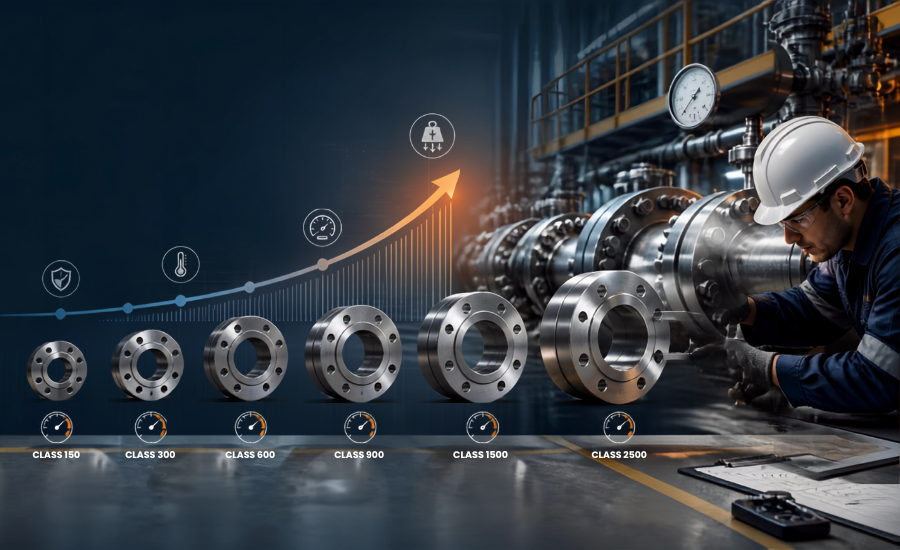
Flange ratings such as Class 150, Class 300, Class 600, Class 900, Class 1500, and Class 2500 are commonly used in ASME-based piping systems. But what do these numbers actually mean?
A common misconception is that Class 300 flange can simply withstand 300 psi, or Class 600 can withstand 600 psi. That’s not how flange pressure classes work.
Let’s break it down.
What Does a Flange Pressure Class Mean?
The “Class” designation represents a pressure-temperature rating system, rather than a direct pressure value.
In other words, a Class 600 flange does not automatically have a maximum working pressure of 600 psi. The allowable pressure depends on factors such as:
- Flange material
- Operating temperature
- Applicable ASME standard
- Flange design
- Material grade
- Pressure-temperature rating table
As temperature increases, the allowable working pressure can decrease. Therefore, both pressure and temperature must be considered when selecting a flange.
Understanding Class 150 to Class 2500
The most commonly encountered ASME flange pressure classes include:
| Flange Class | General Application |
| Class 150 | Lower-pressure general industrial services |
| Class 300 | Moderate-pressure applications |
| Class 600 | Higher-pressure process systems |
| Class 900 | High-pressure industrial applications |
| Class 1500 | Very high-pressure services |
| Class 2500 | Extremely demanding pressure applications |
These classes provide engineers with different levels of pressure capability for designing piping systems according to their operating requirements.
Class 150: A Popular Choice for General Applications
Class 150 flanges are widely used in general industrial piping because they provide a practical and economical solution for lower-pressure services.
They can be found in applications such as:
- Water systems
- HVAC piping
- General process lines
- Utility services
- Low-pressure industrial pipelines
However, the actual allowable pressure must still be determined from the applicable pressure-temperature rating rather than assuming a fixed 150 psi limit.
Class 300: More Pressure Capability
Moving up to Class 300 provides a higher pressure-temperature rating than Class 150 for compatible materials and conditions.
Class 300 flanges are commonly used in:
- Chemical processing
- Petrochemical plants
- Oil and gas systems
- Steam services
- Industrial process piping
They are a popular choice where Class 150 may not provide sufficient pressure capability.
Class 600: Designed for More Demanding Service
When operating conditions become more severe, Class 600 flanges can provide significantly greater pressure capability.
They are often found in applications involving higher-pressure process fluids, hydrocarbons, steam, and other demanding services.
At this level, correct material selection, gasket compatibility, bolting, flange facing, and installation become increasingly important.
Class 900 and Class 1500: High-Pressure Applications
Class 900 and Class 1500 flanges are designed for significantly higher pressure-temperature requirements.
They are commonly associated with demanding applications in:
- Oil refineries
- Petrochemical facilities
- Power generation
- Oil and gas processing
- High-pressure process systems
At these pressure levels, even small errors in component selection or installation can have serious consequences. Engineering specifications and applicable standards should therefore be followed carefully.
Class 2500: For Extreme Pressure Conditions
At the upper end of the commonly used ASME flange classes is Class 2500.
These flanges are intended for highly demanding applications where piping systems must operate under extremely high pressure and/or temperature conditions.
They are typically used in specialised industrial services where standard lower-rated flanges would not provide the required pressure capability.
Because Class 2500 components can be substantially heavier and more expensive, they should be selected based on actual engineering requirements rather than simply choosing the highest available rating.
Why Temperature Matters
One of the most important concepts in flange selection is the pressure-temperature relationship.
A flange material may be capable of handling a certain pressure at a lower temperature, but its allowable pressure can decrease as operating temperature rises.
For example, a flange operating at ambient temperature may have a considerably higher allowable pressure than the same flange material operating at an elevated temperature.
Therefore, selecting a flange solely based on pipeline pressure can be dangerous.
Engineers should always refer to the relevant ASME pressure-temperature tables for the specific material and class.
Don’t Forget the Other Components
A flange connection is only as strong and reliable as the system around it.
Selecting a higher-rated flange does not automatically make the entire piping system suitable for higher pressure.
The following should also be evaluated:
1. Pipe Rating: The pipe wall thickness and material must be suitable for the intended pressure and temperature.
2. Gasket: The gasket must be compatible with the flange facing, pressure, temperature, and process fluid.
3. Bolting: Bolts and nuts must provide adequate strength and be compatible with the operating environment.
4. Flange Facing: Raised Face (RF), Flat Face (FF), and Ring Type Joint (RTJ) configurations have different sealing characteristics and applications.
5. Material: Carbon steel, stainless steel flanges, alloy steel, and other materials have different pressure-temperature capabilities.
How Do You Choose the Right Flange Class?
A practical selection process should begin with the actual operating conditions.
Consider:
Operating pressure: What is the maximum design pressure?
Operating temperature: What is the maximum and minimum design temperature?
Fluid: Is the process medium corrosive, toxic, flammable, or hazardous?
Material: Which flange material is compatible with the application?
Applicable standard: Which ASME or project specification governs the piping system?
Safety requirements: Is the pipeline part of a critical or high-risk process?
The correct flange class should then be selected using the applicable pressure-temperature rating tables.
Higher Class Doesn’t Always Mean Better
It can be tempting to choose a higher-rated flange “just to be safe.” However, this isn’t always the most practical engineering decision.
Higher-class flanges can be heavier, more expensive, and more difficult to install. They may also require different bolting, gaskets, valves, and other compatible components.
The objective is not to choose the highest class. It is to choose the appropriate class for the actual design conditions while meeting the required safety margin and applicable standards.
Final Thoughts
Understanding flange pressure classes is essential for anyone involved in industrial piping design, procurement, installation, or maintenance.
Class 150 through Class 2500 provide different pressure-temperature capabilities, but the class number itself should never be treated as the maximum allowable pressure in psi.
The correct selection requires consideration of pressure, temperature, material, gasket, bolting, flange facing, and applicable standards.
When the right flange class is matched with the right materials and installation practices, it can provide a reliable connection capable of performing safely under demanding industrial conditions.
In flange selection, the right rating isn’t simply about choosing a bigger number—it’s about choosing the rating that correctly matches the entire operating environment.